REVIEW · SEVILLE
12 o’Clock – Bike & Tapas Tour Seville
Book on Viator →Operated by Seebybike · Bookable on Viator
Seville clicks into place on two wheels. This 3-hour bike-and-tapas loop links landmark exteriors with real neighborhood turns, led in English by small-group guides. Bikes roll fast, and Seville’s story keeps moving.
I love that the ride includes lunch and alcoholic beverages, so you’re not hunting for food mid-tour. I also love the way the plan mixes classic sites (cathedral, Alcázar, Plaza de España) with streets that feel lived-in, like Barrio Santa Cruz and Triana.
One thing to think about: it’s a bike tour, so you need comfort riding for the full loop, and the tour requires good weather to run.
In This Review
- Key takeaways before you book
- Setting Off at 12:00: gear, pace, and why the timing works
- Cathedral, Giralda, and Torre del Oro: power you can see from the street
- Barrio Santa Cruz lanes and Triana streets: the neighborhoods that make Seville feel like Seville
- Real Alcázar exteriors and Iglesia de Santa Ana: styles that mix and never match neatly
- Plaza de España, Parque de María Luisa, and Plaza de America: the 1929 vision you can walk
- Real Fábrica de Tabacos and Palau de San Telmo: when the city reuses its big structures
- Tapas lunch and drinks: the break that makes the whole ride better
- Price and fit: is $155.42 good value for Seville?
- Should you book the 12 o’Clock Bike & Tapas Tour?
- FAQ
- How long is the 12 o’Clock Bike & Tapas Tour?
- What language is the tour offered in?
- What is included in the price?
- How many people are in the group?
- What time does the tour start, and where do we meet?
- Is admission required for the stops?
- What happens if the weather is poor or I need to cancel?
Key takeaways before you book
- Max 8 people means you can actually ask questions and keep up with your group
- Lunch plus alcoholic drinks included turns sightseeing into a real break
- Bikes, helmets, baskets, and maps are provided, so you show up ready
- Barrio Santa Cruz and Triana give you both the postcard lanes and the working-city vibe
- Plaza de España and María Luisa Park are the big visual payoff for the afternoon
- Stops are mostly admission-free for viewing, so you spend time riding, not booking
Setting Off at 12:00: gear, pace, and why the timing works
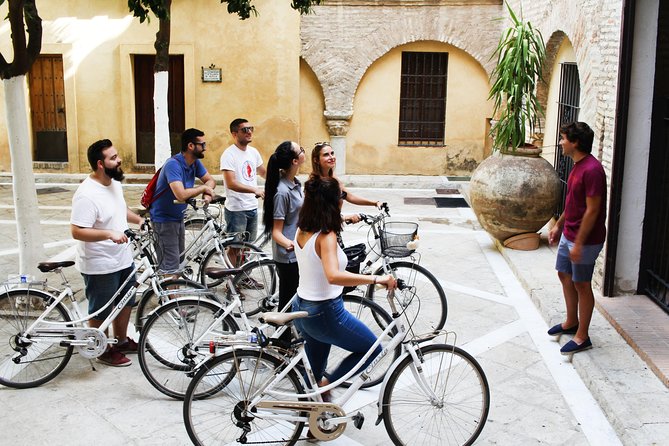
This is a 12:00 pm start, and that’s a clever choice. You beat some of the midday crush, but you’re also not stuck doing a morning rush. The tour is designed for about 3 hours, and you come back to the starting point when you’re done.
The company provides the practical stuff: bikes, helmets, baskets, and maps. That matters more than it sounds. In Seville, your comfort on the bike changes everything—especially when you’re bouncing between cathedral-area streets, tighter old-lane neighborhoods, and open plazas. With baskets, you can keep your hands free for photos and your route notes.
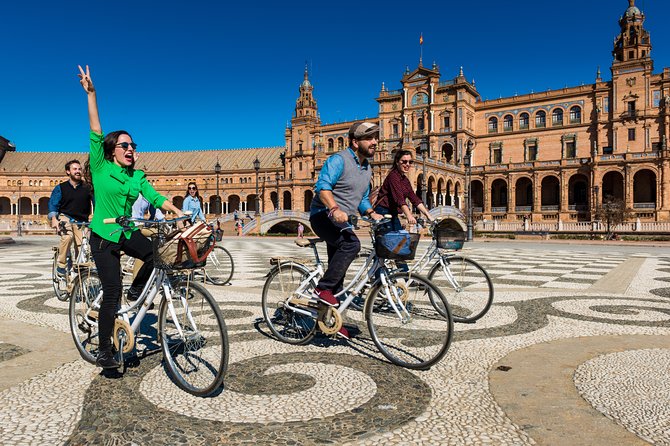
Group size stays small, with a maximum of 8 travelers. In a bigger crowd, bike tours can feel like a moving traffic jam. Here, you’re more likely to get personal explanations and quick guidance on where to look next.
You can also read our reviews of more tours and experiences in Seville.


Cathedral, Giralda, and Torre del Oro: power you can see from the street
You’ll start with the Seville Cathedral area—specifically the exteriors. Even when you’re only seeing the outside, the scale hits you. It’s described as the biggest Gothic cathedral in the world, and just standing nearby helps you understand why Seville’s religious center shaped so much around it.
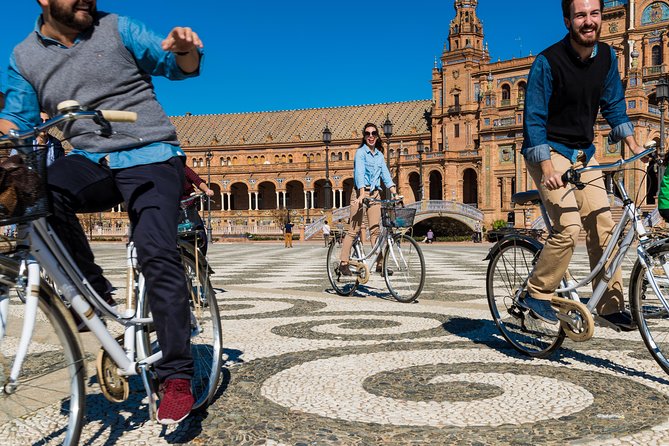
From there, you link to two more iconic towers: the Torre Giralda and the Torre del Oro. The Giralda started life as the minaret for the Great Mosque of Seville in al-Andalus, and the mix of eras is part of the point. The Torre del Oro dates to the 13th century and connects to Seville’s port control—this is the city watching who comes and goes.
Then you’re not just collecting photos. You’re learning how buildings tell stories about power: religious authority near the center, and maritime control along the water routes. It’s a great way to get bearings fast, especially if you’re only here for a few days.
Barrio Santa Cruz lanes and Triana streets: the neighborhoods that make Seville feel like Seville
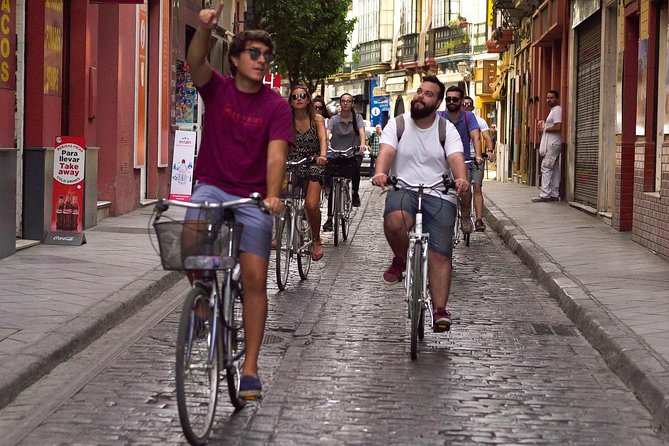
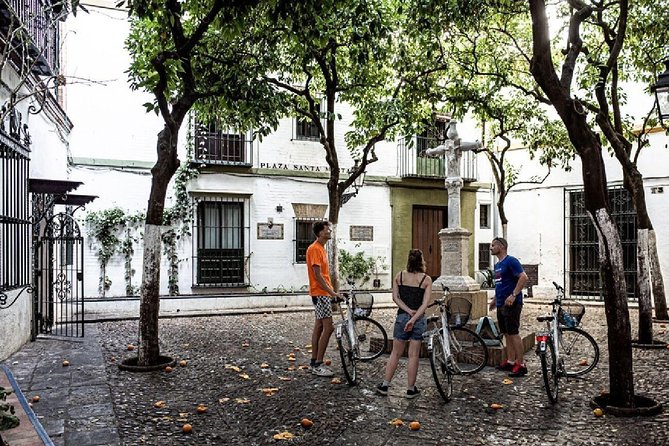
After the big landmark zone, the ride shifts into neighborhoods that feel personal. Barrio Santa Cruz is the former Jewish quarter and is also the oldest neighborhood of Seville. You’ll get time to wander those romantic squares and side alleys—exactly the kind of place where one wrong turn turns into a great memory.
What I like about this part is the contrast. Santa Cruz gives you the maze of old lanes and atmospheric corners. Triana swings you toward craft and culture. Triana is tied to a tradition of pottery and tile work, and it’s also known for its flamenco culture and its own festivals.
This is where a bike tour earns its keep. You cover distance without giving up the chance to step off and look around. If you’re someone who likes photo moments but hates doing a whole day of standing in lines, this section is a sweet spot.
Practical tip: bring your energy. Old neighborhoods can have rougher ground and tighter spacing than the open plazas. You’ll move slower when you stop for views, but that’s the point—this isn’t just a sightseeing conveyor belt.
Real Alcázar exteriors and Iglesia de Santa Ana: styles that mix and never match neatly
The Real Alcázar of Seville is famous for mixing influences, and you’ll see it from the outside. The palace combines Moorish, Gothic, Mudéjar, and Renaissance elements, which is Seville’s style in a nutshell: nothing stays in only one historical box for long.
Then you go to Iglesia de Santa Ana, one of the city’s older churches (dating to 1276). The style is listed as Gothic-Mudéjar, and the description points to a high, vaulted interior and lots of religious imagery. Even if you’re not touring the inside, the setting and architecture context help you understand why Seville’s sacred buildings feel both grand and human-scale at the same time.
I like this grouping because it keeps the theme moving. You’re not jumping randomly from one famous thing to another. You’re seeing how Moorish-rooted and medieval Christian forms coexist, then stepping into a church that carries that same blended language.
If you’re the type who usually “just looks,” this section encourages you to look harder: notice how shapes repeat across eras, and how Seville never fully forgets its previous layers.
Plaza de España, Parque de María Luisa, and Plaza de America: the 1929 vision you can walk
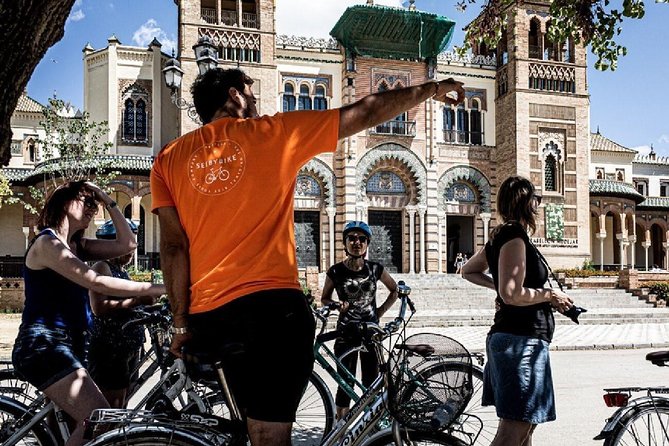
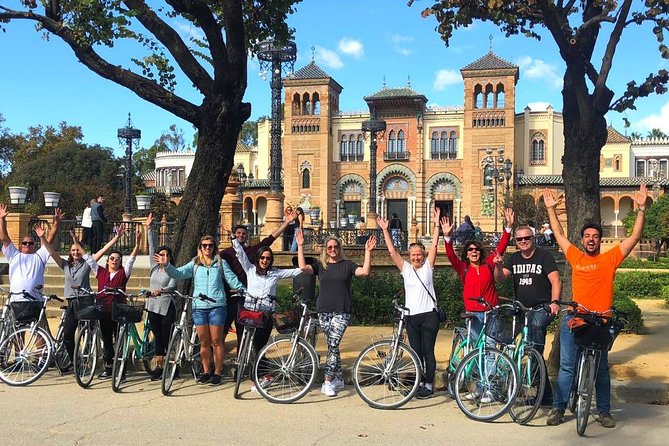
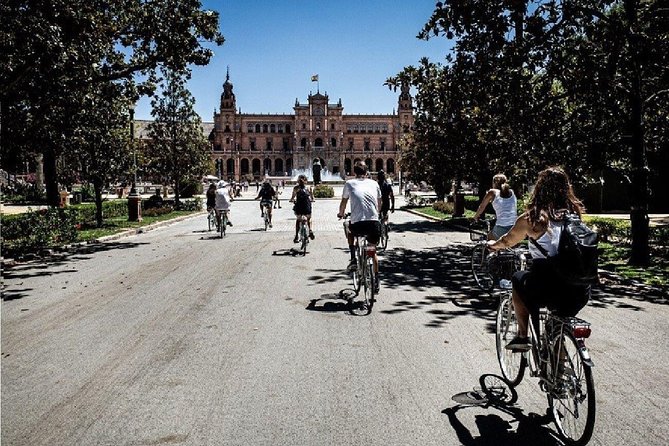
This is where the tour turns into a visual payoff. Plaza de España is one of Seville’s biggest landmarks, built for the 1929 Exposiciones Universales. The scale and grandeur are the whole story here. You’ll have time to take it in, and with that space you can photograph at your own pace instead of racing the group.
Next comes Parque de María Luisa, a large green area right beside Plaza de España. You’ll pass or see the shady avenues lined with lots of exotic trees, plus fairytale-like buildings and colorful tiled benches. There are also Moorish fountains and pools, which helps explain why the park feels like more than a break between attractions.
Then you reach Plaza de America inside the same park area. It’s described as being flanked by three major buildings with distinct styles: the Museum of Popular Arts (Neo-Mudéjar) to the north, the Archaeological Museum (Neo-Renaissance) to the south, and the Royal Pavilion (Gothic style) to the east. Again, it’s Seville showing multiple layers at once—but with a clean, easy-to-walk layout.
What makes this section worth the time is pacing. You’re not just seeing big names. You’re learning how Seville staged an international showcase in 1929, then turned it into spaces locals still use and enjoy.




Real Fábrica de Tabacos and Palau de San Telmo: when the city reuses its big structures
Seville has lots of historic buildings. What helps on this tour is that you’re shown what those buildings are now, not only what they used to be.
You’ll stop at the Real Fábrica de Tabacos, which is described as the site of a major tobacco factory that became the University of Seville today. The tour includes time for you to have a look inside. That inside time is important. It lets you see how the city repurposed a huge industrial structure into something academic and everyday.
After that, you visit Palau de San Telmo, described as Seville’s finest example of baroque style. It was originally constructed as the seat of the University of Navigators. Even if you’re not deep into architectural terms, the baroque label matters: think dramatic forms, strong presence, and a building built to impress.
Together, these two stops give you a practical angle on Seville’s past. It’s not just museum mode. The city keeps using big spaces, and the tour helps you notice that difference.
Tapas lunch and drinks: the break that makes the whole ride better
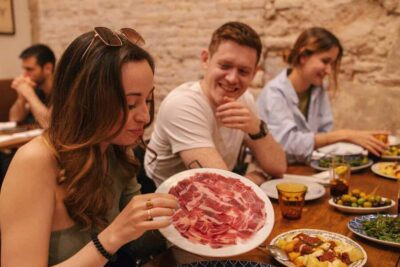
Lunch is included, along with alcoholic beverages. That turns the experience from a quick route into something you’ll actually remember as a day. It’s also a smart travel strategy: you eat with the tour plan, not around it.
This kind of included meal tends to do two things well. First, it slows the schedule down at the right moment, so you can reset before the next cluster of sights. Second, it gives your guide a real chance to point you toward places you can visit after the tour, when you’re tired and hungry and need a plan.
The guides associated with this tour style their advice with local practicality. For example, some guides named in the experience—like Antonio Caballos, Javi, Iván, and Miguel—are described as funny, story-driven, and focused on good food and what to do next. That means your lunch often comes with more than just calories. You get a direction for the rest of your Seville days.
If you’re trying to build a trip itinerary without wasting time, this is one of the most valuable parts. You leave with better instincts for where to go for tapas and which experiences match your mood.
Price and fit: is $155.42 good value for Seville?
At $155.42 per person, this isn’t a budget-only bike tour. But it also isn’t “pay for the bike, pay again for everything else.” You’re paying for the full setup: bike gear, a timed route to multiple major areas, and the key comfort items—lunch plus alcoholic beverages included.
The small group size (max 8) also affects value. When a tour is crowded, you lose time and attention. Here, you’re more likely to get clearer guidance, faster photo stops, and fewer moments of the group lagging behind.
The route also covers a lot of heavy-hitter names in about three hours, with many of the stops listed as admission-free for the time you’re there. That’s a practical win if you want to see the highlights without turning your vacation into a ticket-queue marathon.
Who this fits best:
- First-timers who want to get bearings quickly
- People who like cycling but don’t want a full-day grind
- Travelers who want both landmarks and real neighborhood streets
Who might think twice:
- If you’re not comfortable biking for the full loop
- If weather is iffy, because the tour requires good weather to run
Should you book the 12 o’Clock Bike & Tapas Tour?
I’d book it if you want an efficient first Seville day with built-in food and drinks, and if you’re okay riding between classic monuments and side-neighborhood lanes. The small group size is the quiet superpower here, and the lunch inclusion makes the whole thing feel like more than a sightseeing checklist.
Skip it only if cycling is a hard no for you, or if you’re traveling at a time when weather might be unstable and you’d rather not risk schedule changes.
If you want one plan that helps you understand Seville fast, this one does the job.
FAQ
How long is the 12 o’Clock Bike & Tapas Tour?
It lasts about 3 hours.
What language is the tour offered in?
The tour is offered in English.
What is included in the price?
The price includes bikes, helmets, baskets, maps, lunch, and alcoholic beverages.
How many people are in the group?
The tour has a maximum of 8 travelers.
What time does the tour start, and where do we meet?
It starts at 12:00 pm. The meeting point is C. Pastor y Landero, 4, Casco Antiguo, 41001 Sevilla, Spain.
Is admission required for the stops?
The stops are listed as admission ticket free for the time you’re there.
What happens if the weather is poor or I need to cancel?
This tour requires good weather. If it’s canceled due to poor weather, you’ll be offered a different date or a full refund. Free cancellation is available up to 24 hours in advance for a full refund.